
Tell your friends about this item:
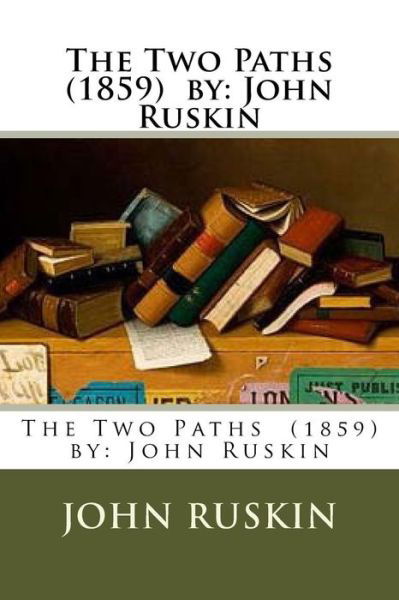
The Two Paths John Ruskin


The Two Paths
John Ruskin
Publisher Marketing: As I passed, last summer, for the first time, through the north of Scotland, it seemed to me that there was a peculiar painfulness in its scenery, caused by the non-manifestation of the powers of human art. I had never travelled in, nor even heard or conceived of such a country before; nor, though I had passed much of my life amidst mountain scenery in the south, was I before aware how much of its charm depended on the little gracefulnesses and tendernesses of human work, which are mingled with the beauty of the Alps, or spared by their desolation. It is true that the art which carves and colours the front of a Swiss cottage is not of any very exalted kind; yet it testifies to the completeness and the delicacy of the faculties of the mountaineer; it is true that the remnants of tower and battlement, which afford footing to the wild vine on the Alpine promontory, form but a small part of the great serration of its rocks; and yet it is just that fragment of their broken outline which gives them their pathetic power, and historical majesty. And this element among the wilds of our own country I found wholly wanting. The Highland cottage is literally a heap of gray stones, choked up, rather than roofed over, with black peat and withered heather; the only approach to an effort at decoration consists in the placing of the clods of protective peat obliquely on its roof, so as to give a diagonal arrangement of lines, looking somewhat as if the surface had been scored over by a gigantic claymore. Contributor Bio: Ruskin, John John Ruskin ( 1819 - 1900) was the leading English art critic of the Victorian era, also an art patron, draughtsman, watercolourist, a prominent social thinker and philanthropist. He wrote on subjects ranging from geology to architecture, myth to ornithology, literature to education, and botany to political economy. His writing styles and literary forms were equally varied. Ruskin penned essays and treatises, poetry and lectures, travel guides and manuals, letters and even a fairy tale. The elaborate style that characterised his earliest writing on art was later superseded by a preference for plainer language designed to communicate his ideas more effectively. In all of his writing, he emphasised the connections between nature, art and society. He also made detailed sketches and paintings of rocks, plants, birds, landscapes, and architectural structures and ornamentation. He was hugely influential in the latter half of the 19th century, and up to the First World War. After a period of relative decline, his reputation has steadily improved since the 1960s with the publication of numerous academic studies of his work. Today, his ideas and concerns are widely recognised as having anticipated interest in environmentalism, sustainability and craft.
| Media | Books Paperback Book (Book with soft cover and glued back) |
| Released | May 12, 2014 |
| ISBN13 | 9781499340709 |
| Publishers | Createspace |
| Pages | 92 |
| Dimensions | 152 × 229 × 5 mm · 136 g |
More by John Ruskin
Show all




![Cover for John Ruskin · The Crown of Wild Olive [microform]: Four Lectures on Industry and War (Paperback Book) (2021)](https://imusic.b-cdn.net/images/item/original/363/9781015009363.jpg?john-ruskin-2021-the-crown-of-wild-olive-microform-four-lectures-on-industry-and-war-paperback-book&class=scaled&v=1642670107)
More from this series


See all of John Ruskin ( e.g. Paperback Book , Hardcover Book , Book , Book pack and CD-ROM )