
Tell your friends about this item:
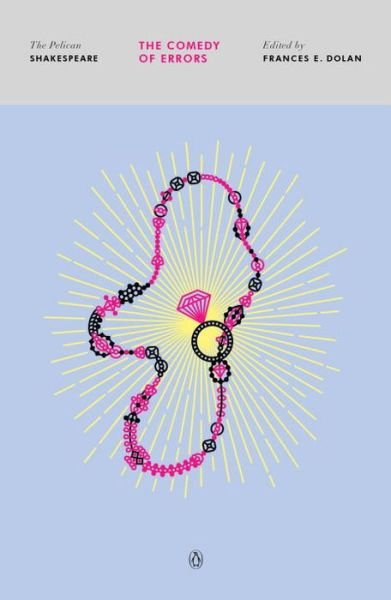
The Comedy of Errors William Shakespeare
Our customers say:


Also available as:
The Comedy of Errors
William Shakespeare
Publisher Marketing: The Comedy of Errors is one of William Shakespeare's early plays. It is his shortest and one of his most farcical comedies, with a major part of the humour coming from slapstick and mistaken identity, in addition to puns and word play. The Comedy of Errors (along with The Tempest) is one of only two of Shakespeare's plays to observe the classical unities. It has been adapted for opera, stage, screen and musical theatre. The Comedy of Errors tells the story of two sets of identical twins that were accidentally separated at birth. Antipholus of Syracuse and his servant, Dromio of Syracuse, arrive in Ephesus, which turns out to be the home of their twin brothers, Antipholus of Ephesus and his servant, Dromio of Ephesus. When the Syracusans encounter the friends and families of their twins, a series of wild mishaps based on mistaken identities lead to wrongful beatings, a near-seduction, the arrest of Antipholus of Ephesus, and false accusations of infidelity, theft, madness, and demonic possession. Key plot elements are taken from two Roman comedies of Plautus. From his Menaechmi comes the main premise of mistaken identity between identical twins with the same name, plus some of the stock characters such as the comic courtesan. In Menaechmi one of the twins is from Epidamnus; Shakespeare changes this to Ephesus and includes many allusions to St Paul's Epistle to the Ephesians. From Plautus' Amphitryon he borrows the twin servants with the same name, plus the scene in Act 3 where a husband is shut out of his house while his wife mistakenly dines with a look-alike. The frame story of Egeon and Emilia derives from Apollonius of Tyre, also a source for Twelfth Night and Pericles, Prince of Tyre. For centuries, scholars found little thematic depth in The Comedy of Errors. Its origins in The Menaechmi led many to see the play as a light, farcical work. It was often assumed that Shakespeare was deliberately avoiding the more serious themes of his histories, tragedies or later comedies. In the eighteenth century the quality of a play was judged by its adherence to the classical unities, as specified by Aristotle in the fourth century BC. The Comedy of Errors and The Tempest were the only two of Shakespeare's plays to comply with this somewhat artificial standard. Recent scholarship, however, has taken a different view. Particularly notable in the play is a series of social relationships, which, if rooted in a Roman past, acquire special significance in the transition to early modernity that constantly guides Shakespeare's drama. As Eric Heinze has noted, those relationships include dichotomies of master-servant, husband-wife, parent-child, native-alien, buyer-seller, and monarch-parliament. Each relationship is in crisis as it sheds its feudal forms, and confronts the market forces of early modern Europe. Review Citations: Library Journal 10/15/1999 pg. 112 (EAN 9780140714746, Paperback) Contributor Bio: Shakespeare, William Arguably the greatest English-language playwright, William Shakespeare was a seventeenth-century writer and dramatist, and is known as the "Bard of Avon." Under the patronage of Queen Elizabeth I, he penned more than 30 plays, 154 sonnets, and numerous narrative poems and short verses. Equally accomplished in histories, tragedies, comedy, and romance, Shakespeare's most famous works include Romeo and Juliet, Hamlet, Macbeth, King Lear, The Taming of the Shrew, and As You Like It. Like many of his contemporaries, including Christopher Marlowe, Shakespeare began his career on the stage, eventually rising to become part-owner of Lord Chamberlain's Men, a popular dramatic company of his day, and of the storied Globe Theatre in London. Extremely popular in his lifetime, Shakespeare's works continue to resonate more than three hundred years after his death. His plays are performed more often than any other playwright's, have been translated into every major language in the world, and are studied widely by scholars and students.
| Media | Books Paperback Book (Book with soft cover and glued back) |
| Released | January 9, 2014 |
| ISBN13 | 9781494964085 |
| Publishers | Createspace |
| Pages | 88 |
| Dimensions | 156 × 234 × 5 mm · 136 g |
More by William Shakespeare
Show all





More from this series
![Cover for William Shakespeare · The Comedy of Errors (Modern Library Classics) (Paperback Book) [Reprint edition] (2011)](https://imusic.b-cdn.net/images/item/original/337/9780812969337.jpg?william-shakespeare-2011-the-comedy-of-errors-modern-library-classics-paperback-book&class=scaled&v=1410010326)


![Cover for William Shakespeare · The Comedy of Errors - The New Cambridge Shakespeare (Paperback Book) [Updated edition] (2004)](https://imusic.b-cdn.net/images/item/original/168/9780521535168.jpg?william-shakespeare-2004-the-comedy-of-errors-the-new-cambridge-shakespeare-paperback-book&class=scaled&v=1401617182)
![Cover for William Shakespeare · The Comedy of Errors - The Pelican Shakespeare (Paperback Book) [Revised edition] (1999)](https://imusic.b-cdn.net/images/item/original/746/9780140714746.jpg?william-shakespeare-1999-the-comedy-of-errors-the-pelican-shakespeare-paperback-book&class=scaled&v=1408557875)
![Cover for William Shakespeare · The Comedy of Errors. Dutch (Tredition Classics) (Dutch Edition) (Paperback Book) [Dutch edition] (2013)](https://imusic.b-cdn.net/images/item/original/944/9783849540944.jpg?william-shakespeare-2013-the-comedy-of-errors-dutch-tredition-classics-dutch-edition-paperback-book&class=scaled&v=1409862806)

![Cover for William Shakespeare · The Comedy Of Errors: Newly Revised Edition (Paperback Book) [Revised edition] (2002)](https://imusic.b-cdn.net/images/item/original/391/9780451528391.jpg?william-shakespeare-2002-the-comedy-of-errors-newly-revised-edition-paperback-book&class=scaled&v=1409619880)
![Cover for William Shakespeare · The Comedy of Errors: The Cambridge Dover Wilson Shakespeare - Cambridge Library Collection - Shakespeare and Renaissance Drama (Paperback Book) [2 Revised edition] (2009)](https://imusic.b-cdn.net/images/item/original/777/9781108005777.jpg?william-shakespeare-2009-the-comedy-of-errors-the-cambridge-dover-wilson-shakespeare-cambridge-library-collection-shakespeare-and-renaissance-drama-paperback-book&class=scaled&v=1401617186)

See all of William Shakespeare ( e.g. Paperback Book , Hardcover Book , Book , CD and Audiobook (CD) )