Tell your friends about this item:
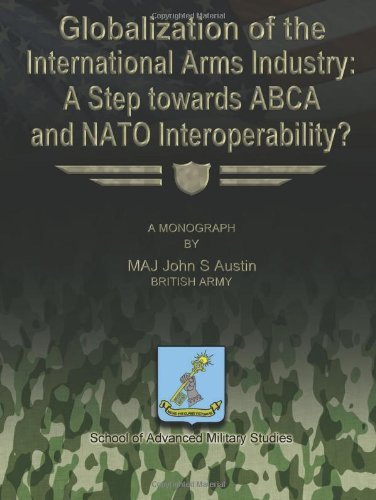
Globalization of the International Arms Industry: a Step Towards Abca and Nato Interoperability? Maj John S. Austin British Army
Ordered from remote warehouse
Our customers say:


Globalization of the International Arms Industry: a Step Towards Abca and Nato Interoperability?
Maj John S. Austin British Army
This paper explores the relationship between globalization of the arms industry and interoperability. Its premise is that while the arms industry has undertaken significant steps to globalize, NATO and ABCA military force interoperability levels remain woefully inadequate. Over sixty years ago NATO and the ABCA program sought to standardize the militaries of their member nations. Each member country agreed to take steps to ensure that interoperability among force elements was achieved. A truly globalized arms industry offers a platform to achieve greater standardization and interoperability amongst joint and combined forces. In fact, it is clear that a nexus should exist between a globalized arms development and truly interoperable forces. This study examines the relationship between a globalized arms industry and interoperable armed forces within the context of NATO and the ABCA program. The primary vehicle it uses to do this is a case study of the development and procurement of the Joint Strike Fighter (JSF). The study concludes that four barriers bar the development of interoperable forces. First, defense spending has significantly reduced for all members of NATO and ABCA, with the exception of the United States. Second, democratically elected leaders are unable to justify increased defense spending in financially constrained times. The absence of an identifiable external threat to the sovereignty of nation states is paramount in politician?s minds. Thirdly, the proliferation of defense technologies to third parties prevents the arms industry from achieving interoperability of systems. Finally, little emphasis is placed on the importance of non technical interoperability. The requirement of forces to train together and understand differing military cultures and doctrine is often overlooked. The absence of joint and combined training prior to conducting operations has limited the ability of international forces to operate together effectively. Critically, wherever possible, NATO and ABCA forces must achieve both technical and non technical interoperability in order to remain effective within the contemporary operating environment.
| Media | Books Paperback Book (Book with soft cover and glued back) |
| Released | September 30, 2012 |
| ISBN13 | 9781480022850 |
| Publishers | CreateSpace Independent Publishing Platf |
| Pages | 52 |
| Dimensions | 3 × 216 × 279 mm · 145 g |
| Language | English |
| Contributor | School of Advanced Military Studies |